The Birth Apartment of Bohuslav Martinů
The Martinů family moved to the tower of St. James’ Church in September 1889, following Ferdinand’s appointment as a tower watchman. His youngest son, Bohuslav, was born here on 8th December 1890, and the family lived there until he was almost twelve years old. Living thirty-six meters above the ground made an indelible impression on him and, in later years while he was living abroad, he carried a picture of the tower wherever he went. The position of watchman was abolished in 1920 and the apartment was cleared. The public was able to visit for the first time in 1947, but it was not until 1958 that it was furnished with the Martinů family’s furniture to resemble the room of the composer’s childhood.
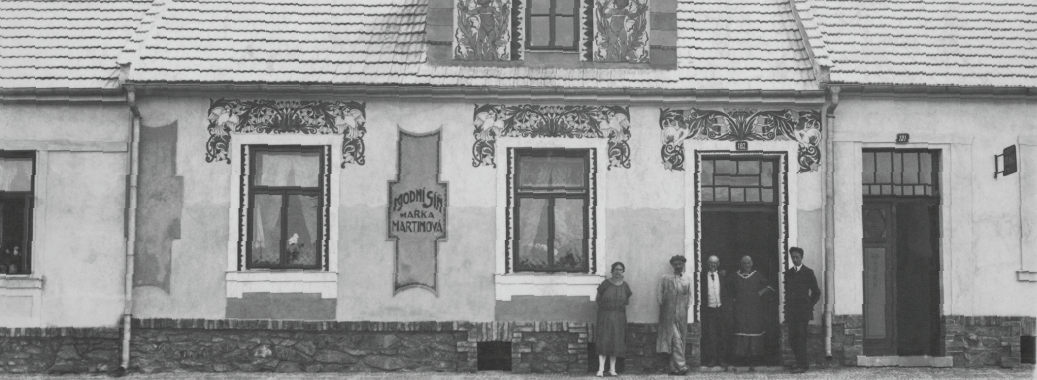
The House at the Rose, Riegrova 52
Whilst living in the tower, the family had to fetch the drinking water from the town. The nearest fountain used to be located near the House at the Rose. Rainwater was collected on the gallery and used for washing clothes and other domestic chores.
The house of Josef Černovský, Otakarova 76
Josef Černovský was Bohuslav’s first violin teacher. Despite being a tailor, he had a reputation as the best music teacher in Polička and, as a dedicated amateur musician, was deeply involved in the town’s musical life. From him, Bohuslav learned not only how to play the instrument, but also the musical theory and what is required from the violinist in the chamber setting. Even after many years, Martinů praised the influence of his first teacher, whose famous love for music and for his pupils had a great impact on him.
“In my memories, nobody can replace him. Even though he was not qualified to teach – he had no diploma or anything of the sort – it was like that in our time; we accepted what was given. Nevertheless, he had such a love for music and art that he might not have realised himself. And he was the first who showed me direction.”
House № 112, Šaff’s street (Šaffova ulice)
The building used to be the seat of the boys’ primary and middle schools attended by Bohuslav since 1897. He was an average pupil; often ill and very reluctant to share his knowledge. Until 1929, the building also served as a theatre and hosted the performances by the amateur drama society Tyl. One of its members was also Ferdinand Martinů, composer’s father – a kind-hearted cordwainer who never spoiled any fun. Young Bohuš was often present during rehearsals, witnessing first-hand how theatre performances were created.
During the First World War, Martinů worked as a music teacher here. One of his students later shared this memory. “We knew Bohuš Martinů as a violin virtuoso of the Philharmonic Orchestra and were amazed when he appeared at the school as our teacher. Our minds couldn’t comprehend that he, the artist, was willing to spend time on us, the ‘screechers’ – as we were called by everyone at school. This did not unsettle our new teacher in the slightest; he befriended us quickly and became more of a friend than a teacher.”
House № 160, Palacký’s Square (Palackého náměstí)
The family moved from the tower to the town in 1902. After the years of isolation, the twelve-year-old Bohuslav found himself at the heart of town life – the main town square. Ferdinand was appointed as the caretaker of the Mayor’s office and the savings bank as both institutions were located in the same building. To the left of the entrance, the family occupied one large room with a small separate kitchen and windows overlooking the town square. Bohuslav would usually practise the violin on the stairs leading to the loft; his sister started a profitable dressmaking business, which she expanded significantly at the house on Svépomoc Street, where the Martinů family moved in 1922.
House № 8, Masaryk’s Street (Masarykova ulice)
At the same time as his appointment to the boys’ school as a violin teacher, Martinů started to teach music privately. In 1916, Martinů established a little private music school, teaching violin and piano, which he ran with brief breaks until 1920.
The pub On the Corner, the corner of Šaff’s and Eim’s Street (Šaffova ulice, Eimova ulice)
The pub used to stand on the site of the current house № 37. Here, Martinů sketched his “Foxtrot born ‘On the Corner’” on the edge of a newspaper. The manuscript has been lost to time; however, two different arrangements by the band leader and composer’s teacher, Josef Vintr, have survived.
Tyl House Theatre
Tyl House was built in 1929 and Bohuslav Martinů was in attendance during the opening ceremony. For this occasion, he composed a piano piece “Prélude” which he performed. The world premiere of “The Opening of the Wells” took place here under the direction of composer’s friend, Zdeněk Zouhar, performed by the Opus choir.
Liboháj
In the south-westerly direction from the town centre lies the Liboháj forest park. In the past, there was a spa here and a pub, and in in the 1920s, an amphitheatre was built where many a play was performed by amateur dramatic societies. In Martinů’s youth, this was a popular place for the townspeople to take a stroll or to have a picnic or two.
The Jan Hus Memorial was erected here in 1921. The bronze relief mounted on a granite boulder in the middle of the forest was created by Vojtěch Eduard Šaff, a sculptor born in Polička. Martinů himself remembered it from his daily constitutionals as well as the inscription written below: “Seek the truth, hear the truth, learn the truth, love the truth, speak the truth, hold the truth, defend the truth until your last breath.”
Train Station
The train station bore witness to many of Martinů’s journeys from his youth up to 1938, as the train was for many years the only way to reach distant places. From here, Martinů travelled to Prague (first as a student at the Conservatoire and later as a member of the Czech Philharmonic Orchestra) and departed for many summer trips and holidays. It was also his final destination when he returned annually in late 1920s and 30s for the summer months from his beloved Paris, where he had found a home. From this station, it was just a short walk to the house on Svépomoc Street, where his family lived. His last visit took place in the summer of 1938; subsequent historical events made any further return to Polička impossible.
The Old Cemetery
The Martinů family’s tomb is located on the left of St. Michael’s Church. It is the final resting place of the composer’s parents, his wife Charlotte and, since 1979, the composer himself. The original humble headstone was removed in 1984 and replaced by an imposing granite memorial created by sculptor Milan Knobloch. The granite features musical motifs alongside an excerpt from the cantata “The Opening of the Wells”.
Since 2025, the last resting place of prof. PhDr. Jaroslav Mihule, CSc, a world-renown Martinů scholar and honorary citizen of Polička, can be found near the composer’s memorial.
The statue of Bohuslav Martinů in the Municipal Park
This larger-than-life statue was created in 1990 to commemorate the 100th anniversary of the composer’s birth. Like the memorial at the cemetery, the statue is the work of Milan Knobloch. As part of his creative process, the sculptor interviewed Jiří Mucha, who shared his memories of Bohuslav Martinů. “Mr. Mucha told me that he has to be inconspicuous, almost shy and that, I believe, I managed to capture successfully in this statue”. The unveiling ceremony was held in the presence of Václav Havel, then president of the Czech Republic.